For bootstrapped SaaS founders at $1M–$3M · Fractional COO mentoring

You built something real. In ninety days, you stop being the bottleneck.

Right now, everything routes through you. Ninety days from now, it doesn't.

There's a second job in your business that nobody ever told you was a separate job. You're doing it badly, at night, on top of the one you're actually good at.

I've spent my career doing that job in other people's companies. I'm not coming to do it in yours. We build it into the business together, so that when I go, it stays.

Three to five founders at a time. Month one, a written 90-day plan. Then you run it, with me alongside, until you don't need me, and you get your Sunday evenings back.

Help me get out of the middle of it

Thirty minutes, free, no pitch. You'll finish the call knowing where the bottleneck actually is.

Not a coach. An operator: co-founded Bucket.io, sold it to ScoreApp in 2024.

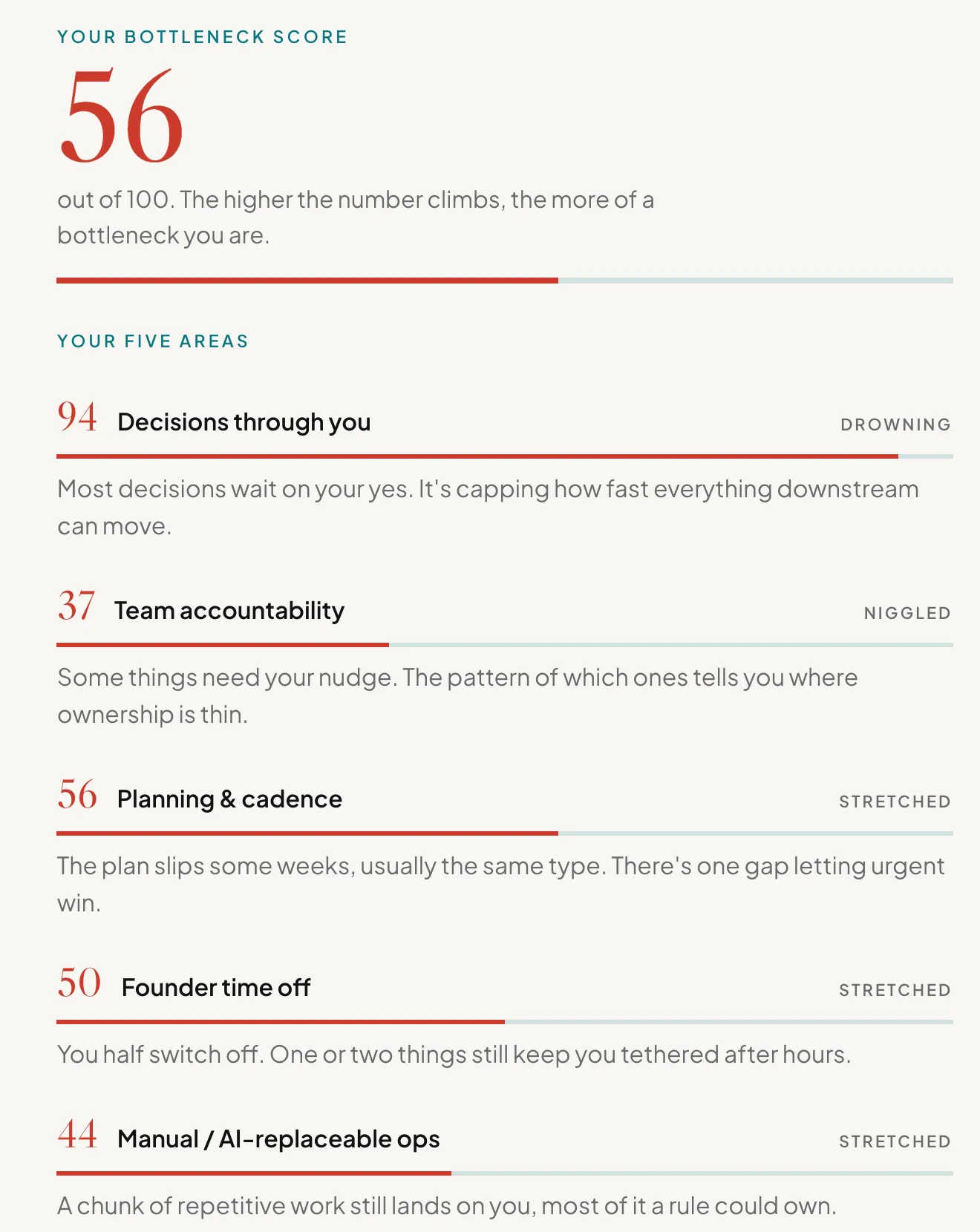
Not ready to talk? Find out what kind of bottleneck you are. Two minutes →

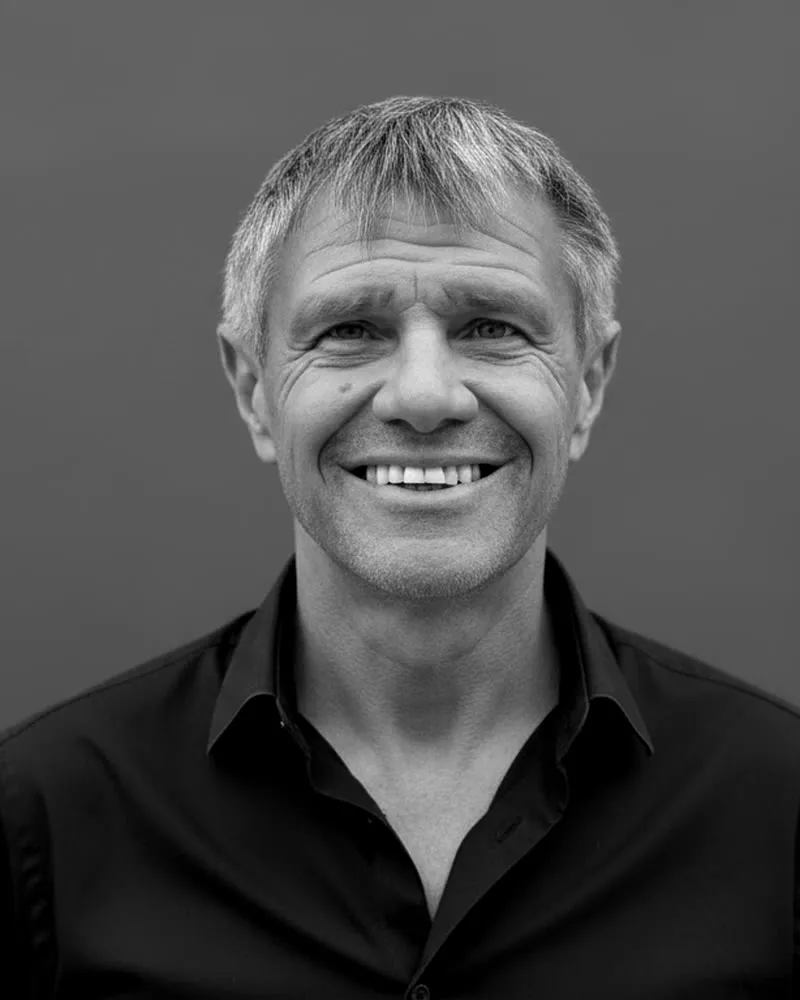
Richard Cussons

The operating record

Bucket.io·The ASK Method Company·Guardian Media Group·7× Inc. 5000

Two built and sold. One I'm still in. Seven Inc 5000 rankings between them.

The problem

The same goals as last quarter. And the quarter before that.

The business has a plan. The plan has goals. They're the same goals as last quarter, and the quarter before that. Meanwhile it's eleven Slack messages before 9am, and you could answer nine of them in your sleep. A roadmap that stalls in week three. A hire who's been here four months and still checks with you first. Nothing moves unless you touch it first. The business keeps growing, and your calendar has quietly become the bottleneck.

There's a quieter version of this you don't say out loud. That somewhere along the way you built yourself a job, not a business. That you've become the most stressed person in your own company, and from the outside everything looks solid.

I know what that looks like, because I've been that owner.

Years ago I had a business take off faster than I'd built it to run. I'd sold the thing brilliantly and never built the machine underneath it, so every order, every problem and every decision came back to me. I fixed it, and then I sold it. Before that I spent two years stuck at five grand a month, convinced the ceiling was the market. It wasn't. It was how I'd built the thing.

So it isn't a strategy problem. You've got the strategy. It's the gap between what you decided and what actually gets done.

And here's the part almost nobody says out loud. Some founders can't take a week off without the business needing them back by Wednesday. Others take the holiday, nothing breaks, and that turns out to be worse. Because if it all runs without you, what are you actually for?

I've stopped twice. Sold the portfolio and stepped back in my forties, then again after the Bucket.io exit. Both times I was back inside a year. So I'm not going to tell you the fix is to remove yourself and go sailing, because I tried that. The fix is that you get to choose what you do next, instead of the business choosing for you.

Ryan Levesque wrote this publicly, about the moment he brought me in:

I felt like I had reached the limits of my capabilities as an operator, while also simultaneously serving as the main creative force in the business.

That's the wall. It isn't a character flaw.

It compounds, too. Growth capped at one person's capacity. A team that's learned to wait. And a business worth less every month it depends on you, because that's the first thing a buyer prices.

And I'll say the thing I actually believe, which is that the reward for building a good business shouldn't be a worse job than the one you left. If you wanted to work like this you'd have stayed employed.

It has a name

It isn't a capacity problem. It's a structure problem.

You're doing two jobs. One of them you'd do for free: seeing what's possible, and refusing to stop having ideas. The other is turning that into things that actually happen, on dates, owned by people, with someone accountable for whether they got done.

That second job is the one keeping you up at night, and it was never supposed to be yours.

By now something has probably told you that you're the bottleneck. A quiz, a book, your own quiet arithmetic on a Sunday night. Half the internet is ready to tell founders they're the bottleneck. The useful part is the bit they skip: the bottleneck was never your character. It's the structure that routes every decision through your chair. Character is hard to change. A structure, you can rebuild in a quarter.

The second job has a name, by the way. Integrator. Nobody tells founders it's a separate job, so most of them end up doing it badly at eleven at night, on their own.

The belief keeping you there is that nobody else could run it, because only you can see the whole thing. You're half right. Nobody else can do the first job.

This is usually where a head of ops gets hired, and it doesn't fix it. Not because the hire is wrong. Because hiring into a broken structure doesn't fix the structure, it amplifies it. You review their decisions. You stay involved just to be sure. Now you're doing their job and yours, and nine months on you're still the one everything waits for.

Ryan Levesque hit this wall at a couple of million. He couldn't get The ASK Method Company past himself. I came in to do the second job, and we took it to $24M. I'm still his partner and COO today.

He wrote the whole story publicly, on Facebook, for my sixtieth. He'd said to me, "I think I need a Richard." I told him there was only one of me. His words:

there really is only one Richard Cussons.

Which brings me to the thing I'd want you to hear before we ever talk.

I'm not going to come and be your integrator. And you shouldn't want me to, because a business that depends on me instead of on you has exactly the problem you started with. You'd have moved the dependency, not removed it.

So we do the other thing. We build the second job into your business, together. The decision rights, the operating rhythm, the accountability that makes any of it stick. You install it and you run it, because a structure you were handed is one your team knows you didn't build. Then I'm surplus, which is the point.

What changes

What it looks like when the business stops waiting.

Here's what actually changes, and it's smaller and more boring than you'd expect.

You stop waking up to eleven Slack messages you could answer in your sleep, because the people sending them now know what they're allowed to decide without you. The quarter you planned turns out to be the quarter that happens, which sounds like a low bar until you count how many of the last four managed it.

You get your week back, and the work you always said you'd do if you ever had the time turns out to be where the growth was sitting the whole while.

And eventually you take a week off and nothing breaks. This time that's the point, rather than the thing that unsettles you.

How it works

The Integrator Mentoring Partnership

Month one, I write you the plan. Not a goals list. A 90-day execution plan: what happens, in what order, who owns each piece, and a bar for every item that tells you whether it worked.

Then we build the thing that runs it. The decision rights, so people know what they can settle without you. The operating rhythm, so priorities get looked at on a schedule rather than when something catches fire. The accountability, which is the part everyone skips and the only part that makes the rest hold.

We design those together and you install them. That order matters. A structure you were handed is one your team quietly knows you didn't build, and they'll wait for you to enforce it. One you built yourself, you enforce without thinking about it.

After that, a month looks like this. We meet on a fixed rhythm and work on whatever the actual bottleneck is, not whatever's loudest that week. Anything that can't wait until we next speak comes to me in between.

I should tell you what that's like, because it isn't for everyone. I'll tell you which decision you're avoiding, and I'll ask about it again the next time, and the time after that. If there's someone on the team who isn't working out, we'll be talking about that long before you want to. I'm not unkind about it. I'm just not going to pretend the thing isn't there.

How it goes
1
The call
Thirty minutes, free. You leave knowing where the constraint actually is.
2
The plan
Month one. Written, sequenced, owned, with a bar on every item.
3
The build
We design the structure together, you install it, you run it. Until you don't need me.

I could handle the technical side in my sleep, but when it came to actually building a business I was running on instinct. I was chasing every lead, hoping calls would close, and quietly aware my funnel was leaking. The real win is that I now have a repeatable process instead of hoping each conversation goes well. I can walk into a sales call and actually run it.

Max Heubel, founder, TitanStack

Help me get out of the middle of it

Thirty minutes, free, no pitch. You'll leave knowing where your bottleneck actually is.

The track record

The same job, seven times, ranked.

#462 on the Inc 5000, 2017. Top ten percent of the entire list. That's The ASK Method Company, the year the operating engine went in.

$2M to $24M. I built the system that got it there, so the founder stopped having to be in the room for it.

Bucket.io. No product, no customers, both founders part-time. Three Inc 5000 rankings and an exit to ScoreApp in 2024.

I built the coaching programme that served over 2,000 founders. Same failure, over and over. Which is how you learn to spot it in week one instead of month nine.

I'll tell you what I'm not. I'm not creative. I've never been the one with the ideas.

What I do is take someone else's idea and make it survive contact with a calendar, a team and a budget. It's the whole job, and it's the one I'll teach you to build.

Who you'd be working with
Richard Cussons

I'm still doing the job.

I'm COO and partner at The ASK Method Company today. Present tense, not a story about the nineties.

Forty years of this, and it started underwater. I was a commercial diver and submersible pilot before I was anything else, one of the youngest certified at the time, and I've been over a mile down.

You learn things down there that never leave you. Calm beats panic. The system keeps you alive. The small detail you couldn't be bothered with is the one that gets you. None of that is a metaphor, by the way. It's just how you build something that holds when nobody's watching it.

Read the full story, from commercial diving to the ASK Method exit →

What it costs

What this is cheaper than, and the comparison that actually counts.

A full-time COO$250K+ a year, plus equity
An embedded fractional COO$5–15K a month, for a day or more a week
ThisBilled monthly, and less than both

Those are the two things founders price this against, and both of them are the wrong comparison. Hire either one and the business still runs on somebody being there. You've bought a better bottleneck.

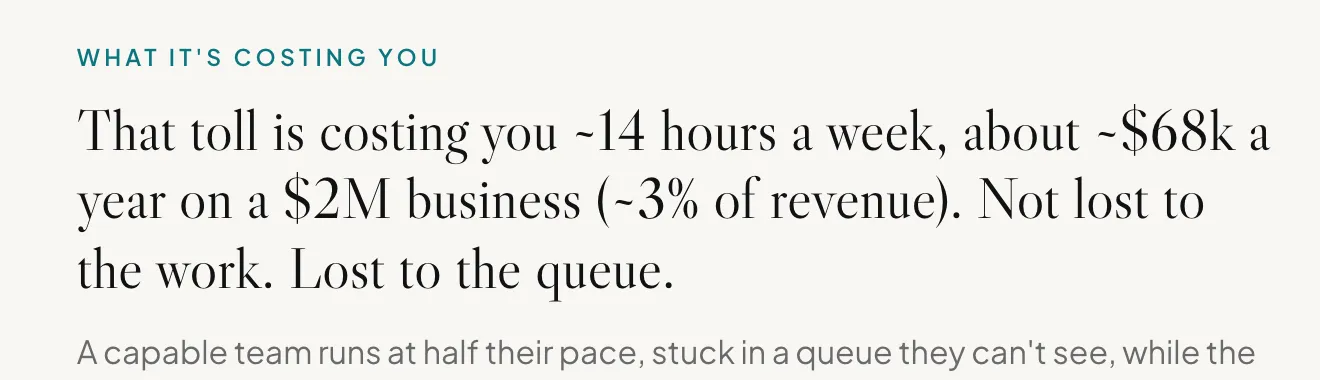
The comparison that counts is simpler than either. Take your last quarter. Count the things on the plan that didn't happen. Put a number on one of them.

It's a monthly partnership, not a one-off. Three months to start, then it rolls on with thirty days' notice and no contract keeping you there. This is for founders ready to invest at the level of a senior hire. If that's a stretch right now, the honest answer is not yet.

Help me get out of the middle of it

Thirty minutes, free. If I'm the wrong spend, I'll say so on the call.

The engagement is built to end.

Three months minimum, then it rolls monthly with thirty days' notice. No long contract, no lock-in.

But that's the small version of it. The real point is that I'm not trying to keep you. Everything we build is built to work without me, because a version of this that depends on me is just the problem again with a different name on it. If you still need me in two years, I've done it badly.

The first call is free. You'll leave it knowing where your actual bottleneck is, even if that's the last we speak.

Common questions

Before we talk.

It's the most common thing I hear, and it's the reason I do this. The hire usually isn't the problem. If there are no clear decision rights, no accountability system and no owner for whether things actually got done, the work comes straight back to you regardless of who's sitting in the chair. Build the structure first. Then the hire works, and so does the next one.

Let's talk

Right now, you're the bottleneck. Ninety days from now, you're not.

We'll have taken the bottleneck out together, and you'll be the one running what replaced it. You keep the plan either way. And if you still need me in two years, I've done it badly.

Help me get out of the middle of it

Thirty minutes, free, no pitch. Three to five founders at a time, and when it's full, it's full.

Not ready to talk? Find out where your bottleneck actually is. Two minutes →